Why Modern Retailers Need a Unified Commerce Platform

One Platform. One View. Every Channel.
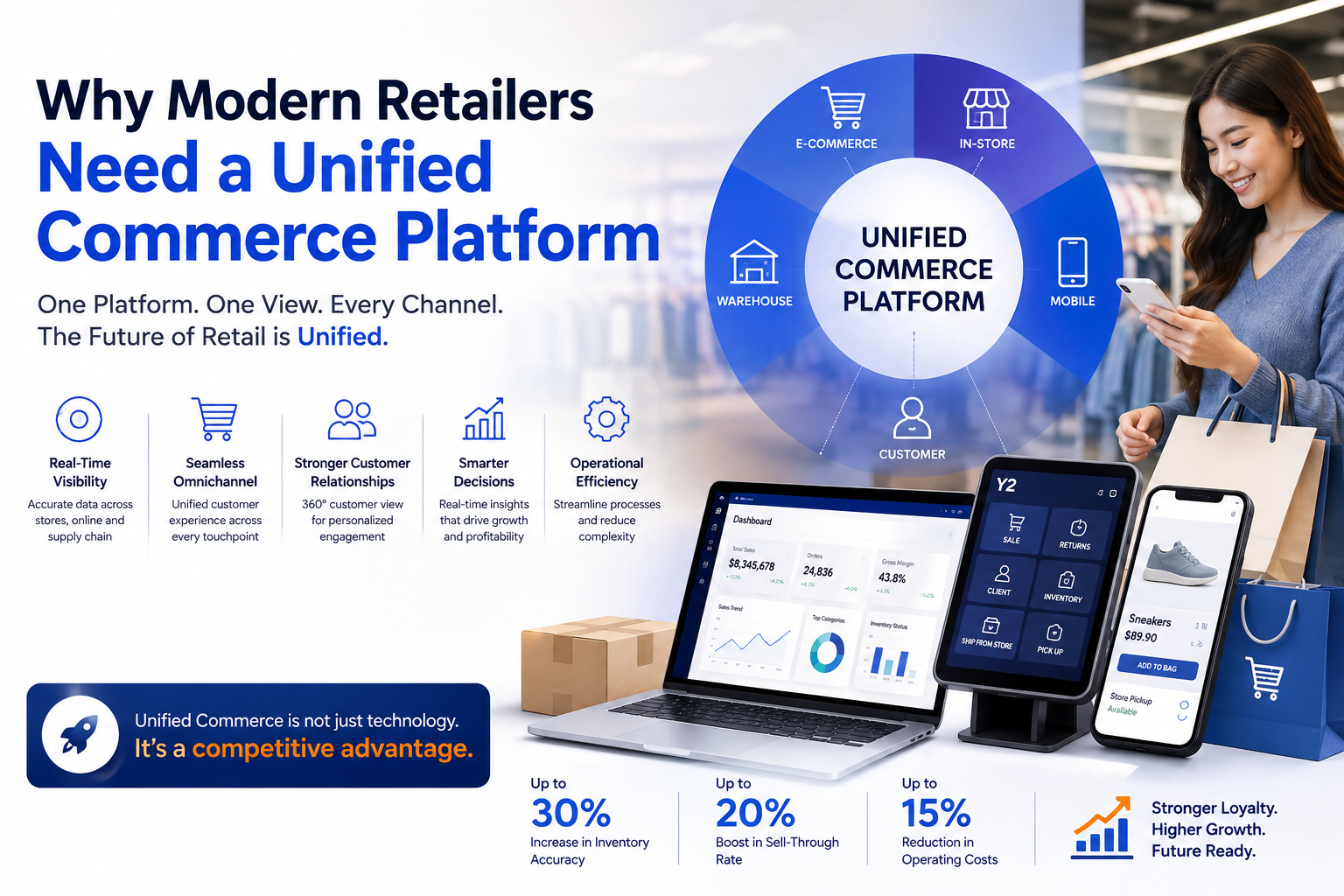 Retail has changed dramatically over the past decade. Customers no longer think in terms of channels. They expect a seamless experience whether they are shopping online, browsing through a mobile app, purchasing in-store, or collecting an order from a pickup point.
Yet many retailers continue to operate with disconnected systems for POS, inventory management, ecommerce, customer loyalty, and store operations. The result is operational inefficiency, inventory inaccuracies, inconsistent customer experiences, and limited visibility across the business.
To remain competitive, retailers are increasingly adopting a Unified Commerce Platform—a modern approach that brings every retail operation into a single ecosystem powered by real-time data.
The Retail Industry Has Changed Forever
Today's consumers expect convenience, speed, and consistency across every touchpoint. A customer may discover a product online, check store availability on their phone, purchase it for store pickup, and later return it through a different channel.
Retailers that cannot support these journeys risk losing sales, damaging customer loyalty, and increasing operational costs.
The challenge: Most retailers still operate multiple disconnected systems that were never designed for modern omnichannel commerce.
The Hidden Cost of Disconnected Retail Systems
Traditional retail environments often rely on separate applications for inventory management, customer relationship management, point of sale, replenishment, reporting, and ecommerce.
While these systems may function individually, the lack of integration creates significant business challenges.
Business Challenge Impact on Retail Operations
Inventory Inaccuracy Lost sales, stockouts, excess inventory
Disconnected Customer Data Poor personalization and loyalty engagement
Manual Replenishment Slow inventory movement and higher markdowns
Limited Reporting Visibility Delayed business decisions
Omnichannel Complexity Higher fulfillment costs and customer dissatisfaction
What Is a Unified Commerce Platform?
A Unified Commerce Platform centralizes retail operations into a single architecture where inventory, sales, customer information, store operations, and fulfillment processes share the same data source.
Rather than synchronizing multiple systems through complex integrations, every department works from a single version of the truth.
This creates real-time visibility across the entire retail organization while simplifying operations and improving customer experiences.
Five Reasons Retailers Are Moving to Unified Commerce
1. Real-Time Inventory Visibility
Inventory accuracy remains one of the biggest challenges facing retailers. Without real-time inventory visibility, businesses frequently experience stock discrepancies, missed sales opportunities, and unnecessary markdowns.
Unified Commerce enables retailers to maintain accurate inventory information across stores, warehouses, and digital channels in real time.
-
Reduce stock discrepancies
-
Improve inventory accuracy
-
Increase product availability
-
Support faster fulfillment decisions
2. Seamless Omnichannel Operations
Modern consumers expect flexibility. They want to buy online, pick up in-store, reserve products, transfer items between locations, and return purchases through any channel.
Unified Commerce allows retailers to manage these processes through a single workflow rather than multiple disconnected systems.
-
Buy Online Pick Up In Store (BOPIS)
-
Ship From Store
-
Endless Aisle
-
Cross-channel returns
-
Store-to-store fulfillment
3. Better Customer Experiences
Customers expect retailers to recognize them regardless of where they shop.
A Unified Commerce Platform consolidates customer interactions, purchase history, loyalty activities, and engagement data into a single customer profile.
This enables retailers to deliver more personalized experiences and strengthen customer loyalty.
4. Smarter Inventory Replenishment
Traditional replenishment processes often rely on spreadsheets, manual calculations, or outdated sales data.
Unified Commerce platforms leverage real-time inventory and sales information to support more intelligent replenishment decisions.
Retailers can allocate inventory based on demand, sales performance, stock thresholds, and product life cycle trends.
5. Faster Decision-Making
In today's market, waiting days or weeks for reports is no longer acceptable.
Unified Commerce gives decision-makers immediate access to operational data across stores, products, customers, and supply chains.
This enables leaders to respond faster to changing consumer behavior and market conditions.
Why Unified Commerce Matters More Than Ever
Economic uncertainty, rising operational costs, increasing customer expectations, and growing competition have made retail execution more complex than ever before.
Retailers can no longer afford fragmented systems that create inefficiencies and limit visibility.
Organizations that embrace Unified Commerce gain significant advantages:
-
Higher inventory accuracy
-
Improved customer satisfaction
-
Reduced operational complexity
-
Faster fulfillment processes
-
Better decision-making capabilities
-
Improved scalability for growth
The Future of Retail Is Unified
Retail transformation is no longer about adding more technology. It is about connecting every part of the retail operation through a single platform that provides visibility, agility, and control.
Unified Commerce empowers retailers to break down operational silos, improve customer experiences, optimize inventory, and support long-term business growth.
As customer expectations continue to evolve, retailers that adopt a unified approach will be better positioned to compete, innovate, and scale in an increasingly complex marketplace.
Ready to Modernize Your Retail Operations?
Discover how a Unified Commerce Platform can help your organization improve inventory accuracy, streamline omnichannel operations, enhance customer experiences, and accelerate growth.
Contact our retail transformation specialists to learn how modern retailers are building the future of commerce.