Customer-Facing Displays in Retail

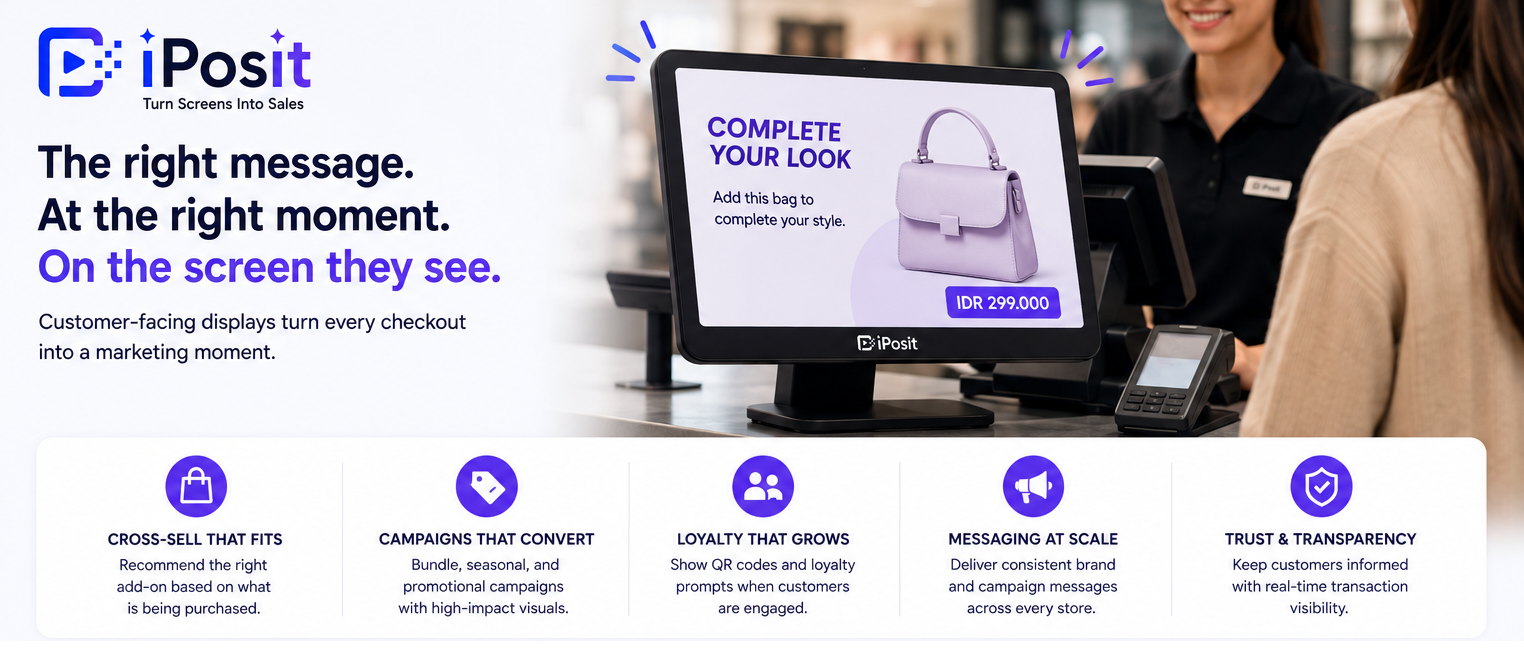 **A customer-facing display is the second screen at the point of sale — the one turned toward the shopper. Traditionally it just mirrored the receipt: items, prices, total. Modern retail treats it as something much more valuable: a guaranteed-attention marketing surface that reaches every single customer at the moment of purchase.
From receipt mirror to media surface
The display earns its place at the counter through transaction transparency — customers trust a register where they can watch items and prices appear. But between scans, during payment processing, and in idle moments, that same screen can carry:
-
Cross-sell recommendations** that react to what is being purchased.
-
Bundle and seasonal campaigns with modern, high-impact visuals.
-
Loyalty prompts — sign-up QR codes shown exactly when the customer is engaged with the transaction.
-
Brand and campaign messaging consistent across every store in the network.
The hardware question
Most modern POS terminals support a second display natively — dual-display configurations are now standard retail hardware (see our note on modern POS hardware and dual displays). If your registers already have a customer screen showing only the transaction, the hardware investment is already made; what is missing is the software layer that puts content on it.
The software layer: what to look for
-
POS integration, not a parallel system. The display should consume product and transaction context from the POS you already run, so campaigns can react at checkout in real time.
-
Central campaign control. Marketing should push a campaign to a store group in seconds — not file a ticket for someone to update each terminal.
-
Store-level targeting. Campaigns scheduled by store group, time window, and promotion objective, so local relevance survives central control.
-
Retail-grade reliability. The screen is part of the checkout; it must stay stable through daily store operations with real-time sync.
-
Analytics. Impressions matter less than what campaigns did to attachment rate and basket value.
Putting it together
iPosit, Integrated Retail’s in-store customer display platform, is that software layer: instant campaign activation on customer-facing screens, store-level control, and campaign analytics, working with POS platforms like Cegid and Retail Pro Prism. Most teams launch their first store in under a week.
For the strategy behind the screen, read in-store retail media and cross-selling at checkout.
Book a demo to see it live on your own store setup.